

Examining the life and beliefs of Ann Lee, founder of the Shaker movement and among the few female religious leaders of the 18th century, Mona Fastvold’s “The Testament of Ann Lee” lays bare the agony and ecstasy that informed Lee’s radical expressions of faith, making for what the director describes as a “speculative retelling” of her story, with Amanda Seyfried delivering a transcendent, tour-de-force performance in the title role.
Born in 1736 to a large family in Manchester, England, Lee grew up poor, illiterate, and with no formal education. With her entire family sleeping in one shared room, she regularly bore witness to her parents having sex, awakening her distaste for physical intimacy. Struggling to find her place within the Church of England, she instead became an early adherent of the “Shaking Quakers,” a sect whose teachings—including that the body and mind could be cleansed of sin through chanting, singing, and shaking during prayer sessions—ran counter to the predominant religion.
Lee started preaching after losing all four of her children in infancy. Renouncing gender roles and the institution of marriage, she preached a gospel of spiritual purity and social equality, telling her followers to commit to a lifetime of celibacy and communal living. The Church of England declared her a heathen and imprisoned her in a mental asylum; following her release, Lee and a small group of followers traveled to America, where they sought to spread their gospel and avoid further persecution.
While in production on her second feature, “The World to Come,” Fastvold had stumbled upon a vast archive of Shaker worship songs, which in turn led her to the story of Ann Lee and her utopian community. Though the Shakers are today better known for their furniture, including chairs they’d customarily keep on the wall when not in use, Fastvold found herself fascinated by Lee’s role as a female religious leader and her efforts to reimagine a different kind of society in late 1700s America.
Lee and her followers worshipped through rapturous song and movement, which Fastvold handled by approaching “The Testament of Ann Lee” as a musical of sorts. Collaborating with choreographer Celia Rowlson-Hall (“Vox Lux”) and composer Daniel Blumberg (“The Brutalist”), who created original songs based on Shaker hymns, the cast and crew committed to a lengthy rehearsal process, learning to combine movement with music ahead of an intense 34-day shoot.
Fastvold directed “The Testament of Ann Lee” and co-wrote it with Brady Corbet, also her husband and creative collaborator; the pair recently collaborated on “The Brutalist,” another immigrant epic—about a fictional Hungarian Jewish architect, László Tóth—that reflected on the interrelatedness of faith and trauma. Fastvold became immersed in “Ann Lee” while still at work on “The Brutalist,” which was made on a similar budget of under $10 million.
Ahead of the film’s limited theatrical release on Dec. 25, which expands throughout January and includes select screenings in 70mm, Fastvold sat down to discuss the commonalities she sees between “The Testament of Ann Lee” and “The Brutalist,” the process of creating this film’s rapturous musical sequences, and the “dreamlike quality” she always seeks in cinema.
This interview has been edited and condensed.
In beginning to discuss this film, I’m struck by certain commonalities between László Tóth and Ann Lee, these two immigrants striving toward impossible dreams, fleeing persecution, even as their trauma informs their faith and its physical manifestations. Ann suffers immensely, but this only seems to deepen her sense of devotion.
Putting out “The Brutalist” and getting to talk about that film last year was a fever dream for me, because I was shooting the last little bit of “Ann Lee” in November, then I was fully entrenched in post-production; the whole time, I was editing. I was just working on the cut and in post, while we were talking about “The Brutalist.”
When we were writing the films, we wrote “The Brutalist” first and “Ann Lee” after. Brady and I both felt that it was completely different, that it had nothing to do with “The Brutalist.” We didn’t see any kind of connection at all. While we were writing it, it was set in a totally different time period and was a musical of sorts, so we felt it was a wildly different kind of film.
Then, I was sitting in the edit room, with a new perspective on “The Brutalist” from being in dialogue with people who had seen it and formed their own minds; I was starting to articulate and hone in on people’s experiences with that film. At the same time, I was doing the same with “Ann Lee,” because that’s what one does in the edit process; you’re just distilling your work. All of a sudden, we started to see so many parallels between the two, down to our obsession with chairs. [laughs]
But what struck me most was that, while they’re both immigrants who arrive in America trying to do something quite impossible, who are driven by trauma in many ways, they move through that trauma in very different ways. The Achilles heel of László Tóth is his ego, I would say. That film deals a lot with that subject of the artist and their ego; in dialogue with Erzsébet, his wife, she keeps asking him why he is letting his ego run wild—and, for Brady and I, a lot of that is a conversation we’re having about how sometimes you need that ego, because it drives you to create something extraordinary, that kind of unwavering belief in yourself.
What is fascinating to me about Ann Lee, the way I interpret her character, is that she is egoless. Her faith, what drives her, is a desperate desire to create a different type of community for others. It’s not about her becoming a famous religious leader, with her saying, “This is the law. You must follow me. This is the only way, and you have to be part of this.”
It’s truly about this idea that “I can’t mother my children, so I’m going to mother the whole world. I’m going to lead them as a mother, with love, and create a space where you can be free to be creative, so you can create incredible architecture, drawings, paintings, and music, and live in peace with different ideas of equality and respect. That lack of ego is interesting to me in a leader, because I haven’t seen it modeled in either religious or political leaders.
It’s fascinating, as well, that both characters create these monuments that will outlast them, but László’s struggle culminates in the existence of this literal, concrete object. In contrast, Ann Lee seeks to nurture a faith, in the form of this community of like-minded individuals—for her, it’s more about daily labor and lifelong devotion.
Whether you’re creating a building, making a film, or writing a book—whatever it is that you are trying to leave behind—that could be an offering to a community. I’m not idealizing Ann Lee and saying that László Tóth was flawed. They’re both incredibly flawed characters in different ways.
The more I looked at it, the more Brady and I felt we were constantly exploring this story: about trying to make something impossible, trying to create impossible things, being a foreigner trying to carve out some space for something challenging, foreign, and difficult. In the end, it all melts down to our private metaphor of trying to make art that’s radical in this world, somehow. [laughs]
As you’re telling a new story, as a filmmaker, you hone in on the same thing over and over again, from different angles, but in the end, I don’t really mind that. I don’t mind that with authors; when I return to writers, it’s because I want to live in their world. I want to be in that universe for a while. I want to be in whatever that quality is; it doesn’t matter that the story isn’t entirely new, you know, right?
I keep feeling drawn to explore faith, perhaps because I was raised in a secular household. I don’t subscribe to any religious community; I’m not part of that. But there is such an intense spirituality in making art. What is this madness that drives you to work for 17 hours in the rain, and why are all these people following you, doing this, recreating a dream you had? Is it madness, or is it some form of spirituality?
This personal tragedy Ann experiences, in the loss of her children, is a turning point in her life, in the film, and you dramatize it by intercutting six or seven different scenes into this dance sequence; there’s such anguish and ecstasy in “Beautiful Treasures.” Tell me about that challenge of telling that part of the story through montage and movement, the combination of which gives rise to this dreamlike atmosphere.
The filmmaking that I gravitate toward the most has a dreamlike quality to its language. Right now, I’m in the city of David Lynch, and I grew up in the world of Ingmar Bergman. These are filmmakers who are spinning stories out of dream logic. There’s always an element of that; I’m striving to find this way for it to feel like a memory or a dream, where you can break those rules of realism but ensure, at the same time, that it’s incredibly grounded.
This particular sequence was incredibly complex to shoot. The film was shot in 34 days, but this sequence took up nearly four days of our shoot. In time, it’s a short section of the film, but it’s also nine years of her life, and it’s the core of why she makes the choices that she makes, and how she ends up where she does. Your empathy for her really lies in the sequence, so it had to work for me to go on this journey with her.
It was challenging, also, because I wanted to be very frank with her body: with the births, the sexuality, the intimacy she has with her babies, with the breast milk and the blood—all of these things needed to be real and truthful. Luckily, I had Amanda Seyfried as my partner and Christopher Abbott as well; they were so generous and open with their bodies, and they understood the importance of being that frank. We were very aligned with that.
Amanda was like, “Let’s go and make some great [birthing vagina] prosthetics. Let’s have this be as real as possible. Let’s lean into the complexity of it all, into the joy between the two of them, into the hopefulness, into the complexity of their sexuality.” We didn’t want her to feel like a victim; she’s not, but becomes this incredibly powerful person and presence. It rang true to me that we wanted to see her in the process of becoming. Then, we have this movement piece that frames it all, and I also wanted to shoot it in three different ways: one young and hopeful, one very pregnant and almost in early labor, and then one completely carved out at the end. And even moving through those movement pieces was really intense and complex.
And then, on top of that, we decided to do several runs of live singing. And so we started in the studio, trying to find a good demo to rehearse with as well. And that was hard because Amanda hadn’t experienced everything we were shooting. We were on the floor, in the dark, singing through tears, through birth, through joy, through ecstasy. Then, we brought in the set recordings and, in the end, we went back to the studio again several times, trying to work on that scream at the climax of “Beautiful Treasures,” that scream that is ecstasy and agony all together. That was a feeling we were searching for. I could have worked on it forever; at one point, it was like, “Pencils down, that’s it.” But it was a very complex part of the film.
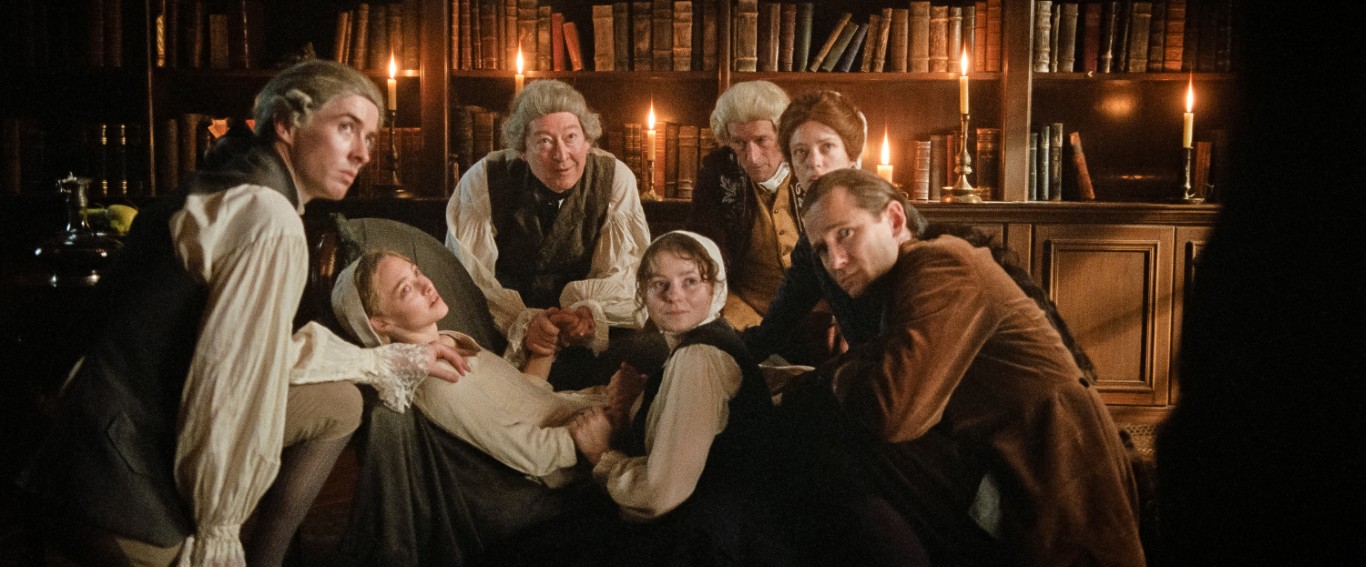
One pivotal sequence that comes soon after, set to a hymn called “Hunger and Thirst,” is a particularly astonishing showcase for Amanda Seyfried; you’re so grounded in Ann’s spiritual state, and you witness her achieve a kind of transcendence between these extremes of emotion. Was that always a long take?
We shot that scene later in the schedule. At that point, we had done so much work together on finding the rhythm between camera movement and performance. That was very important for us to see, and we worked on it so much. I had our cinematographer, William Rexler, and camera operator, Sam Ellison, present during the dance and movement rehearsals with the performers, helping find the right path for everything.
Through rehearsals, I had a strong sense that this should just live in one shot, but I had tried a few other approaches in the first few takes; I was a little further removed from her, originally. It’s a highly striking piece of choreography that Celia Rowlson-Hall created for this scene, and I was really taken by it. We were shooting, and we were holding back to allow us to see that, but then I knew that this felt wrong. It’s not what that scene is about; we need to be really close with her at this moment. This point really aligned Amanda and William; it’s a handheld take, but it’s so smooth. He’s not anticipating her, and she’s not anticipating him; they’re really moving as one. He just lived so beautifully in this close-up with her.
Celia, my choreographer, was in love with that one as well, even though it excluded some of the movement’s beauty. The movement is so specific because Amanda had rehearsed the hell out of it; she knew what every single movement meant. That’s how Celia choreographs; every piece of movement has a very specific story to it. With this movement, she’s shedding the skin off her arm; with this one, she’s feeling where her belly used to be, but it’s gone now. All of these things have such a specific narrative behind them, and it grounds the performance in such a beautiful way.
As we’re discussing, Ann and her followers worshipped through ecstatic song and movement. Your depiction of these displays of devotion is such an achievement; we’re witnessing not only instinctual expressions but a larger, collective spiritual release. In conceiving of and creating these sequences with Celia Rowlson-Hall, as well as your cast, tell me about developing what you’ve called a “communal language of movement.”
That was really detailed work. This isn’t dance, of course; it is movement, and that movement is an expression of faith, and it has a story and a journey to it. I picked the actors I wanted to work with. I didn’t care whether they were dancers or singers. Some of them are incredible in motion, like Thomasin McKenzie; she said, “I’m not a mover,” but then we started going into rehearsals with her, and Celia and I fell in love with the way she moves, especially the articulation of her hands. It’s really beautiful and precise.
Lewis Pullman as well—not a mover, but a drummer, and his mother is an incredible dancer. They were working in advance, and his body language and his way of moving were exciting as well. Christopher Abbott has more of a movement background as well, so he would bring that in; then we had Jamie Bogyo, who was a West End performer with a very different approach to movement. Through storytelling, the idea that every piece of movement has meaning, there is a language for what grounds everybody.
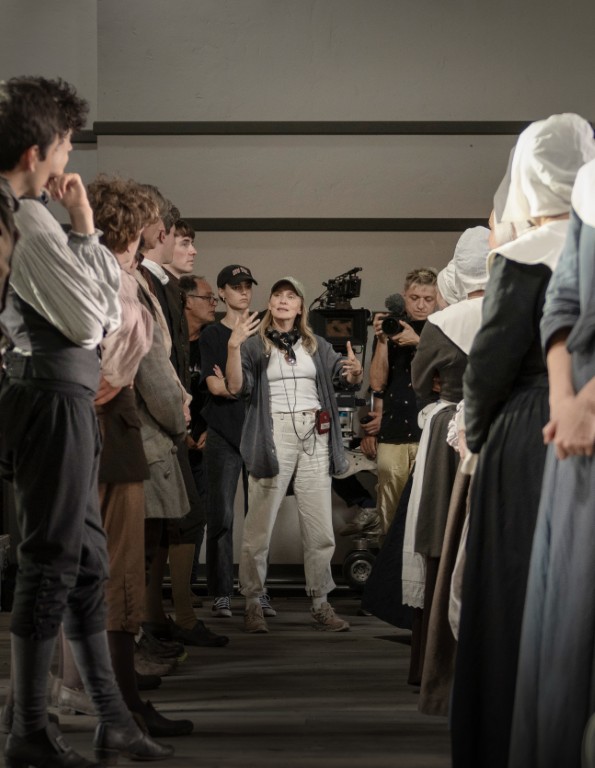
Going around—myself, Celia, her assistant, and Daniel Blumberg, who was also on set the whole time—and constantly communicating with our background performers was essential in those larger pieces of choreography. You cannot have one person in the corner just go crazy, not having a purpose; that ruins the whole shot. You need the sense that all of the performers have a story; even if we were saying that, “this is an improvised moment,” all of our key cast knew—because they’d done all of these workshops and rehearsal periods in advance—you could choose from these five different gestures. Still, you have to commit to it and know what it means to you in the moment.
The specificity of that creates an intoxicating feeling of 170 people having a moment and releasing something from their bodies, letting go of this pain and giving somebody else strength and love, or pulling power into their bodies, or shaking off this incredibly painful sense of shame. With that specificity, all of a sudden, everyone starts moving together as one organism. It’s exciting to be there in the room and experience it. It feels like you want to join in.
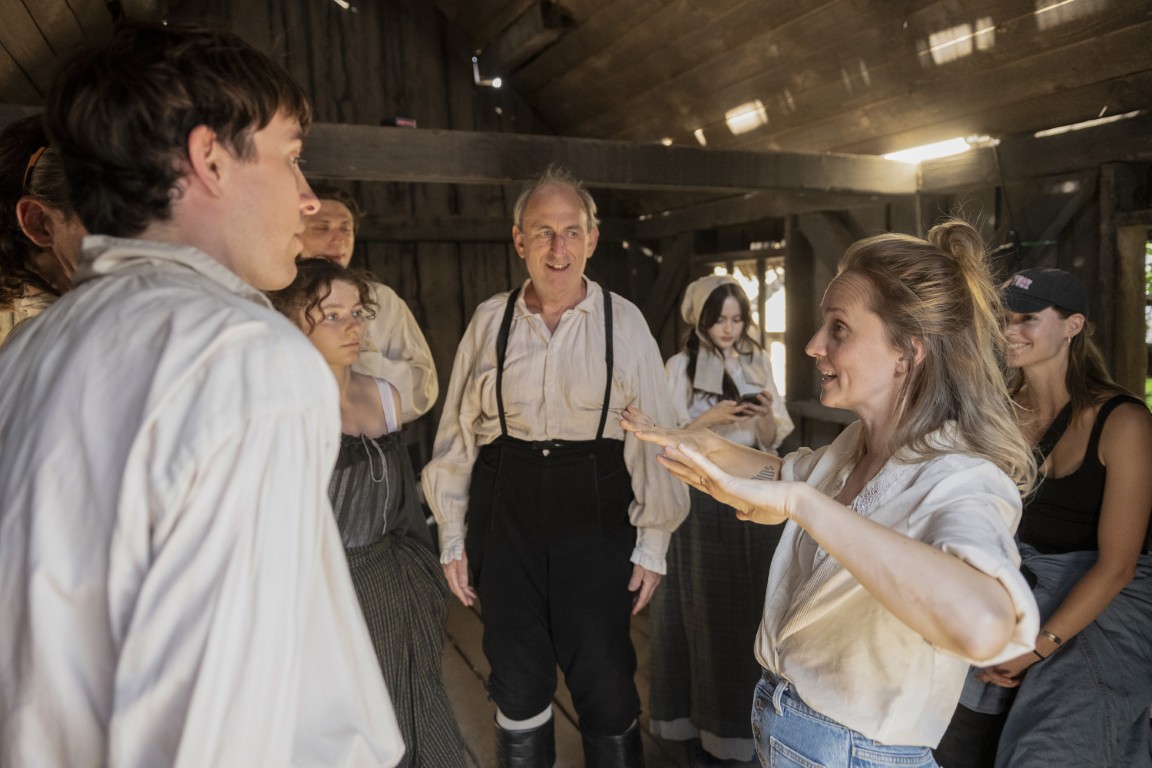
How did you and William Rexler, your director of photography, think about the placement of the camera in these sequences, to shoot all necessary coverage but convey this sense to the audience of being swept up in the ecstasy of worship?
We could have been hanging back and observing the movement, which is tempting when you see a really compelling piece of movement. We had to resist that urge and instead say, “We want the camera to be an active participant in this piece of movement, to be swept up and swirl around with everyone else—to literally be participating.”
There was a lot of rehearsal time required to choreograph their camera movement, as well. We were shooting on film, in scenes lit with hundreds of candles; it’s incredibly complex to execute, but it’s very exciting too, when it all comes together. I like playing close to the edge of darkness, because that feels so right for the period. But you can’t eff it up, because you got 200 dancers, hundreds of candles, and one shot at getting it right. [laughs]
I have to ask the challenge of filming the sequences on the ship that brings Ann Lee and her followers across the ocean — eruptions of movement and hymn in confined spaces, the congregation’s faith tested by this storm rolling in. It was breathtaking for me to see these scenes, to learn that you had only two days to film them aboard a wooden sailing ship, and to experience the sense of scope you achieved. How was any of that possible?
It was really, really hard. We searched for a year for a tall ship because we knew we couldn’t build one. We tried to explore, “Can we build bits and pieces of it?” We absolutely could not. Cannot. “Ann Lee” had a similar budget to “The Brutalist,” around $10 million; we didn’t have the money to do that, but we couldn’t cut it either. What were we going to do: cut to them being suddenly in New York? No, that was impossible, so we had to find a path forward.
Brady and Andrew Morrison, one of our producers, were both so dedicated to finding solutions with me; it was just really exciting. We were searching everywhere. We searched in Malta, we searched in South Africa. There are only so many of these tall ships in the world, and apparently, they all race in a regatta together in the summer, so it was hard to find a boat that would let us shoot on it. And it had to be a tall ship, because that’s what they would travel on back then.
So finally, we find this ship, the Götheborg of Sweden, a beautiful replica of a ship from the period, down to every detail of the ropes and sails, but it has to stay docked because it wasn’t seaworthy at the time. It used to be, and had sailed to China from Gothenburg, but we also couldn’t afford to bring another boat out next to that boat; usually, for filming, you’d take a boat out to sea and then have a follow boat with all your effects, equipment, cameras, and such. That was impossible for us, on our budget.
Instead, we put a rain tower on the dock, and then I couldn’t even afford the crane, which is expensive, so we were rigging an arm off the rain tower. There were moments of true creativity needed to achieve this spectacular, grand moment in the film. I found a few angles that I could shoot on this ship that looked great, especially once I managed to get the sails up; we had to get special people in to do that, because there are only a few people in the world who know how to set the sails on these period ships. So many things had to come together, and if one of them had failed, the whole thing would have gone sideways.
Of course, a ship at sea is supposed to move from side to side, but this one did not, so I had to have the performers sway left and right, to give every single one of them a rhythm to move to, and then counter that movement with the camera. [laughs]
We took a smaller-period ship out to the open sea, with large waves, which we could do, and it was really intense for everyone, but it made for a beautiful part of the movie. I built a tiny little interior set that I could flood, as well, in a barn in Hungary. You turn a corner, then you’re at the real boat; then, you turn a corner, and you’re at the other ship; then, you turn a corner, and you’re back in Hungary; and then you’re in the interior of this real boat. That sequence needed to be pieced together so delicately.
At times, it was so low-rent. There was a man with a bucket of water, throwing it at Amanda off-screen—it was ridiculous. [laughs] But filmmakers would do this 50-60 years ago, even 100 years ago—they would make films this way. I thought about that. There’s model work in this film as well, and a lot of other old-school film techniques. Somehow, the challenges and constraints of my budget are simply reasons to get really creative.
Tell me about finding that headspace, going into an epic production like this with such finite resources. Filmmaking is an act of creation, and it’s a leap of faith; as you stated earlier, the narratives of “The Testament of Ann Lee” and “The Brutalist” can be read as reflecting your own struggle to make radical art. But how inextricable do you feel that the films you’ve made are from the way in which you’ve made them?
It’s definitely linked. I have a philosophy about how I want to make these films. For Brady, Andrew, and I, it’s down to how we work with our collaborators. There is no separation between departments. We are all working together from the get-go. We all move into each other’s offices and spaces, and we all start around our kitchen table. That sense of community is essential to us. We never change the scripts or compromise on the “what,” only on the “how,” so it’s about finding paths, finding ways of doing it, and figuring it out somehow by pushing forward.
It is really hard, and I wish it were less painful at times. Perhaps we will find some more support in the pictures to come. But we are also so determined to keep on telling radical stories and telling them in this way, where we have flexibility, where we can trust whatever we think is right for the story and go ahead with that, even if it seems absolutely impossible.
I’m not yearning to do a massive, big-budget movie. I love the intimacy, freedom, and agility of these projects. It makes for very special pictures, and it allows for a particular type of process. Of course, there are some bigger-budget films I love—like “The Lovers on the Bridge,” famously one of the most expensive films in French history. I don’t know what it made at the box office, and who cares? It’s a masterpiece, and I’m so glad it exists. I don’t mean to throw shade in that direction.
My process involves working with a small group of people I collaborate with; that’s really important and exciting to me. If I can keep that same culture, that same creative freedom, and that same agility while expanding the group, and if I also know that I will be able to reach a larger group of people with a particular story, then perhaps I can add more to it financially. But I would just want everyone to feel like it makes sense.
“The Testament of Ann Lee” is now in theaters, via Searchlight Pictures.
Source link
